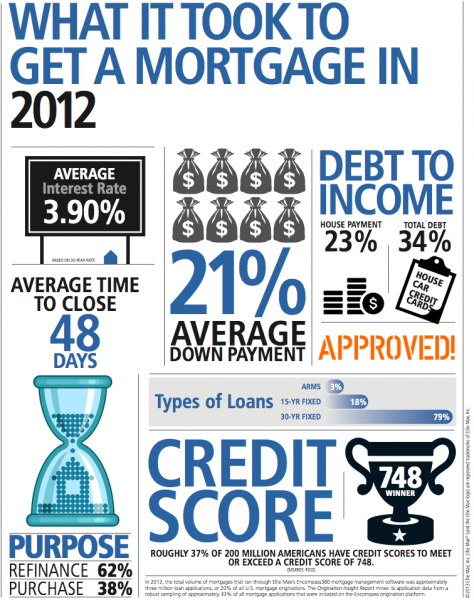
No doubt the majority of buyers searching Knoxville homes for sale will need to secure a mortgage. While lending standards have been strict it hasn’t slowed the Knoxville real estate market. The following infographic from mortgage lending services provider, Ellie Mae, shows us what it took to get a mortgage in 2012.
Fiscal Cliff Avoided, But What Does It Mean For Knoxville Real Estate
What the latest steps to avert the fiscal cliff mean to the Knoxville real estate market.
In order to avoid the fiscal cliff, a budget package was passed by the U.S. Congress on New Years Day. Implications for homeowners and the Knoxville real estate market include: tax rates remaining the same for most households and the extension of mortgage cancellation relief.
The “American Taxpayer Relief Act of 2012’’ that was passed by Congress extends current tax rates for all households earning less than $450,000, and $400,000 for individual filers. Households earning above these limits will see tax rates revert to where they were in 2003, meaning taxpayers in the highest bracket would pay taxes on ordinary income at a rate of 39.6%, up from 35%. The tax rate on capital gains would also remain the same, at 15%, for most households, but for those earning above the $400,000-$450,000 threshold, the rate would rise to 20%.
Troy Stavros, Broker and Partner with the 865 Real Estate team stated, “From a real estate standpoint, this could have gone in a bad direction and gladly did not. With the Congress keeping the provisions for the exclusion from taxes on the sale of a principal residence and important tax exemptions for homeowners, I feel housing can continue on it’s course of positive momentum.”
Good news from a homeowner’s perspective, the exclusion from taxes for gains on the sale of a principal residence of up to $500,000 ($250,000 for individuals) remains intact, so only home sellers whose income is $450,000 or above, AND the gain on the sale of their house is above $500,000 would pay taxes on the excess capital gains at the higher rate. Therefore there is no change for the majority of home sellers.
Extenders, which keep in place expiring tax provisions, are also included. Of most interest to the Knoxville real estate market, the “American Taxpayer Relief Act of 2012’’ would extend mortgage cancellation relief for home owners or sellers who have a portion of their mortgage debt forgiven by their lender. This is typically seen in a short sale or foreclosure sale for sellers or a modification for owners. Without this extension, the debt forgiven would be taxable, adding additional financial burden to already underwater homeowners. Also extended are deductions for state and local property taxes and mortgage insurance premiums, which, along with the mortgage interest deduction, are important tax considerations for home owners and buyers.
Knoxville Real Estate: How will the Fiscal Cliff effect Housing?
Many experts have voiced that implications of the fiscal cliff will lead to changes in homeownership tax provisions and a recession. Troy Stavros, Broker and Partner with the 865 Real Estate team stated, “Although the recovering housing market has made strides towards normalcy this year, these implications will likely undo gains made in one of the economy’s most important sectors.”
Let’s take a closer look at the tax provisions and changes that could lead us to a recession, and look at how they may effect Knoxville real estate.
#1: Mortgage Interest Deduction: This is the largest and oldest housing related subsidy in the U.S. tax code, that “allows homeowners to reduce their taxable income by the amount of interest that has been paid towards their mortgage.” This deduction costs the government about $100 billion each year and has been a focal point of tax code negotiations. Some changes being discussed are: capping the deduction, limiting the number of eligible taxpayers, or eliminating the tax benefit altogether. Changes would not only have an immediate effect on a homeowner’s cash flow, but an immediate negative effect psychologically. Moody’s Chief Economist Mark Zandi state, “The deduction nevertheless has become ingrained in the psyche of home buyers over generations, and reducing it would have real effects. People account for it when they think about how much house they can afford to buy.” Changing the mortgage interest deduction will result in weakening the housing sector.
#2: Mortgage Debt Relief Act of 2007: Passed by Congress at the beginning of the housing crisis, the Mortgage Debt Relief Act shields forgiven mortgage debt from taxable income and is set to expire at the end of 2012. This protection can appear in three scenarios: “when a bank modifies a mortgage to reduce the principal; when a borrower sells her home in a short sale and the purchase price is less than the outstanding balance on the mortgage; and when a bank waives the portion of the mortgage balance it couldn’t recoup in a foreclosure.” Advocates state that allowing the tax break to expire will endanger progress made this year with troubled mortgages.
What will a recession caused by the fiscal cliff do to Knoxville real estate?
#1: Reduce Home Sales: Higher taxes will leave potential homebuyers with less available money to spend on real estate, increasing fears that the housing recovery will be reversed. But if the fiscal cliff brings the U.S. economy back into a recession, higher unemployment and lower wages will have the most profound impact on new home sales. According to the Chief Economist at National Association of Realtors (NAR), Lawrence Yun notes, “Home sales and construction activity depend on steady job growth, which we are seeing, but thus far we’ve only regained half of the jobs lost during the recession.”
#2: More Foreclosures: Another major impact of higher unemployment onset by a recession could be an influx in foreclosures. Forbes noted, “fewer jobs could translate into less demand for new homes, possibly even a wave of foreclosure filings as newly unemployed workers struggle to make mortgage payments.” The CBO reported that an inability to avoid the fiscal cliff could cost Americans 2 million jobs in 2013 and keep unemployment around 8.0% through 2014. Allowing the Mortgage Debt Relief Act to expire may compound the issue. Homeowners who are selling homes through short sales – purchasing a home for less than is owed on the existing mortgage – may choose to foreclosure on homes rather than be taxed on the unpaid portion of their mortgage. Ultimately, more foreclosures will have a negative effect on the housing market by bringing down home values.
#3: Rental Prices Move Higher: Low interest rates and low home prices have resulted in making Knoxville homes more affordable, but strict mortgage credit requirements have slowed the growth in homeownership. Ben Bernanke, Federal Reserve Chairman, stated “overly tight lending standards may now be preventing creditworthy borrowers from buying homes, thereby slowing the revival in housing and impeding the economic recovery.” Because of this, more potential Knoxville home buyers will continue to stay in the rental market, especially if the country goes into a recession. But rental supply cannot keep pace with the demand. Rents climbed more than 4.0% in 2012 and NAR estimates that number will continue to increase by at least 4.0% through 2015. A report from the Center for American Progress states, “there could be as many as 2.3 million new renters between 2015 and 2020. The result will be an increasingly tighter rental markets and higher rents for many Americans.”
There are big decisions ahead that may ultimately result in big implications for Knoxville real estate. Stay tuned!
Knoxville Real Estate: Visions from the Real Estate Crystal Ball for 2013
Troy Stavros, Broker and Partner with the 865 Real Estate team stated, “As we look into our crystal ball at what we project 2013 to look like, it has positives and negatives for both buyers and sellers of Knoxville real estate. The good news for everyone is that, unless we fall of the fiscal cliff or the Mortgage Interest Deduction gets monkeyed with, the vision is one of a good year for housing.”
Vision #1: Home prices and rents on the rise.
We’ve already seen the lack of new construction raising the national and Knoxville real estate prices in 2012, and we can expect that trend to continue into 2013. Since the housing downturn, national new construction has been at 500,000 units or less for the last 6 years. Experts say construction of new homes and apartments need to be between 1.25 and 1.5 million a year to keep pace with population growth. This shortfall leads to a lack of supply which translates to demand, equaling higher home prices and rents.
Vision #2: Less foreclosure deals and more short sales.
Sales of foreclosed homes fell to approximately 11% of all sales in June 2012, down from about 28% in March 2011. The decrease is partly because the large government entities, along with banks, have been liquidating hundreds of distressed home loans in bulk to purchasers who agree to work out new terms with borrowers rather than foreclosing. Another factor for the drop looks back to our 1st Vision. Rising home prices have improved the equity position of thousands of buyers who were once upside-down.
Also reducing foreclosures is their alternative, the “short sale”. Short sales are deals in which a home sells for less than what the borrower owes on the mortgage, with the bank agreeing to accept the sale in lieu of going through an expensive and time-consuming foreclosure. Within the past few months, FHFA issued new rules on short sales for Fannie Mae and Freddie Mac reducing the documentation that borrowers have to show to demonstrate hardship. Also borrowers now aren’t necessarily required to pay the difference between what they owe on the mortgage and the final sales price. These changes will have national and Knoxville real estate seeing more short sales in 2013.
Vision #3: Higher home construction costs.
Even though levels of home construction are at record lows, costs of building materials like sheet rock, lumber, and copper are on the rise. The last few lean years in construction caused many construction workers to either migrate out of the country or into other occupations, leaving less qualified construction workers. Once again a low supply of workers means they can demand more for their services. Couple the higher material costs with the increased cost of construction labor and that equals higher home construction costs.
Vision #4: Higher mortgage interest rates but loosened lending standards.
The National Association of REALTORS predicts rates will gradually rise to 4% by the end of 2013. While this is still extremely low, economists believe that while we are currently witnessing historically low rates, there is only one way for them to go. Currently, the average credit score of a borrower looking to obtain a mortgage is 760. This is significantly higher than averages in the past, because of an overcorrection by banks coming out of the recession. Look for lending standards to loosen a bit as lenders try to compete for the business.
Knoxville Real Estate: Two Positive Housing Predictions for 2013
On December 10th, mortgage giant, Freddie Mac released it’s U.S. Economic and Housing Market Outlook for December. The report looks ahead to 2013 and gives us a prediction as to what can be expected in the housing market.
Coming off many consecutive months of positive news, the outlook is that the housing market will continue to advance into the new year. The two major points of the report were:
1. Long term mortgage rates should remain near their record low levels through the first half of 2013 and gradually rise during the second half of the year. Even with the second half rise, rates should remain below 4%.
2. Home values should continue to rise with most U.S. price indexes seeing a 2 to 3% increase in 2013.
Freddie Mac’s chief economist, Frank Nothaft stated, “The last few months have brought a spate of favorable news on the U.S. housing market with construction up, more home sales, and home-value growth turning positive. This has been a big change from a year ago, when some analysts worried that the looming ‘shadow inventory’ would keep the housing sector mired in an economic depression. Instead, the housing market is healing, is contributing positively to GDP and is returning to its traditional role of supporting the economic recovery.”
Troy Stavros, Broker and Partner with the 865 Real Estate team added, “What we are seeing in the local Knoxville real estate market is in line with Mr. Northaft’s projections. With the low inventory levels we are witnessing, we could see Knoxville home values rise even faster than predicted. The affordability of housing right now is at historical levels. Buyers are seeing this and entering the market. Lack of Knoxville homes for sale is leading to competition. It doesn’t happen very often when it is a great time to be a buyer and it’s a market where there might be competition for your home if you are a seller. Unless you are currently underwater in your current home, there should be no more excuses, it’s time to get off the fence and into the market.”.
Knoxville Real Estate: Top 2 Reasons for Rising Home Prices
Every week it seems, there is more news that home prices are increasing on a national level. Knoxville homes for sale are definitely following suit. The 865 Real Estate team, the leading Knoxville real estate team at Gables & Gates, REALTORS recently discussed with their clients the top 2 reasons why we are seeing home prices increase. Troy Stavros, Broker and Partner with the 865 Real Estate team stated, “Many of our clients can’t understand how prices can be increasing, when what they keep hearing from the national media is how the market is still bad. The truth is, things aren’t that bad here in Knoxville and in many other parts of the country. Specific factors are leading to the nationwide price increases, so we thought we would educate our clients on them.”
Reason #1: First and foremost, Stavros stated, is what we learned in Economics 101. Supply and Demand. Nationwide the inventory of homes for sale are at historic lows. New homes are at their lowest level seen in 50 years. Existing homes for sale are at a 10 year low. Distressed inventory (i.e. foreclosures) has fallen as well. “Buyers are still out there. A smaller pool of homes to choose from and buyer demand leads to competition for properties. Where competition between sellers might lead to lower prices, competition between buyers leads to higher prices.”
Reason #2: Why is there a demand to buy a home now? Affordability. Stavros said, “Many buyers are not only seeing the chance to buy homes that are at bargain prices, but they are realizing the impact it can make on their budgets. Why is that? Two words: Rates and Rent.” With mortgage interest rates at all time historic lows, a home buyer has more purchasing power than ever before. It wasn’t that long ago that interest rates were 7%, and now they hover around 3.5%. On a $1500 a month, 30 year mortgage payment, today’s rate lets you afford almost $100,000 more house. Stavros says, “That is buying power! Couple that with the rising cost of rent, and renters are coming out of the woodwork to buy homes, and those that aren’t should be.”
The advice of the 865 Real Estate team to local clients scouring Knoxville homes for sale is don’t wait. “If you find something you like, and your agent, after researching tells you the pricing is in line, jump on it. Waiting too long or making a low offer are the too biggest reasons for losing a home you love. With these inventory levels, this is a different market. Old strategies for buying don’t necessarily apply.”